Two women journalists allege Delhi police assault during protest coverage, drawing sharp political fire
The journalists say they were detained and assaulted while covering a protest in Delhi and were headed for medical examination. The allegations have reignited questions about how police handle reporters on the ground, and given the opposition fresh ammunition against the BJP-led city government.

NewX Editorial · Editorial Desk NewX uses AI tools to help research, draft and translate stories. Read our Editorial Policy →
Published:
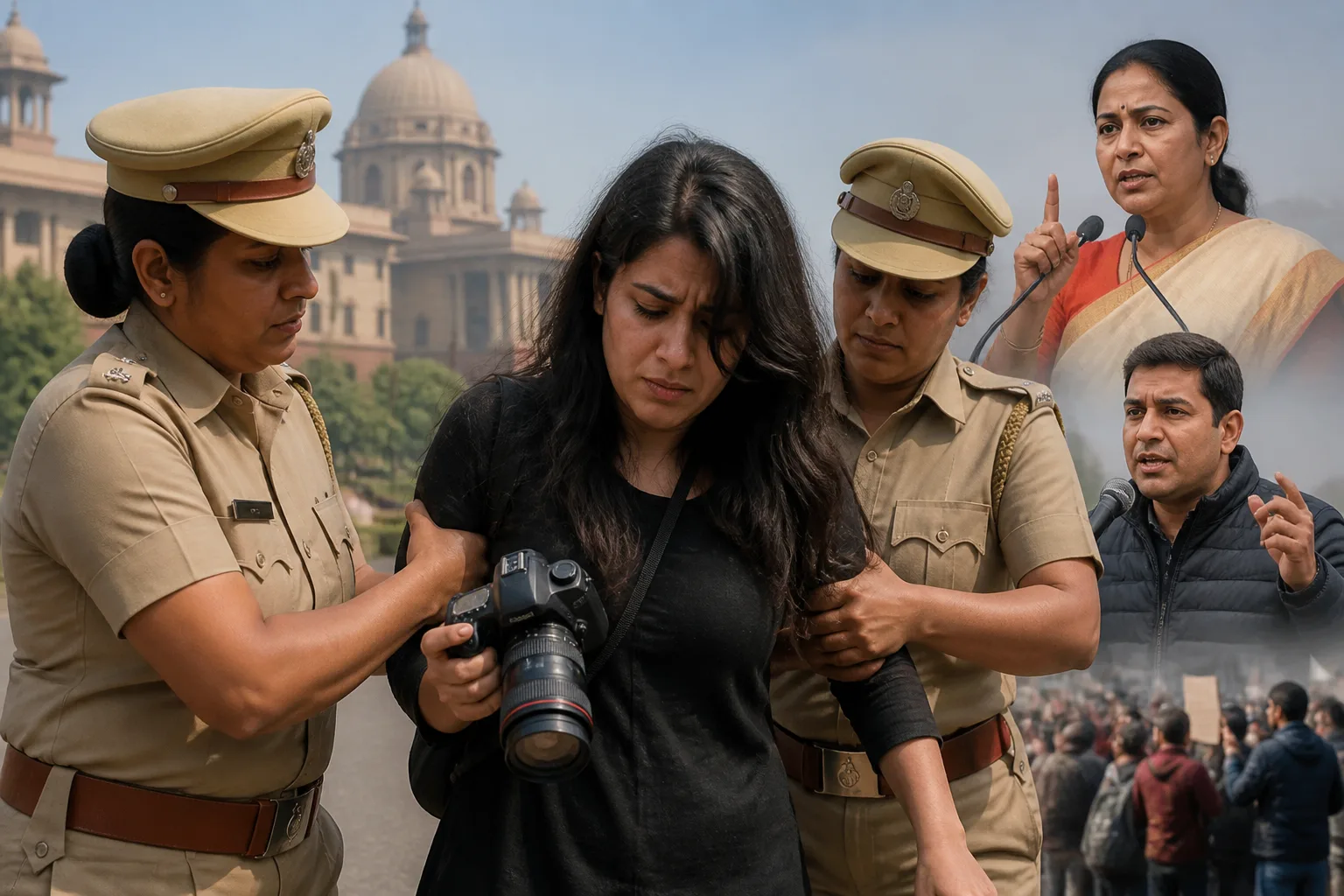
Two women journalists have alleged that Delhi Police detained and assaulted them while they were covering a protest in the capital, an episode that has quickly turned into another flashpoint over press freedom and police conduct in Delhi.
The journalists said they were on their way to AIIMS for medical examination after the incident. Their claims were made public as video and social media posts about the confrontation began circulating widely, adding pressure on police officials and drawing political attacks from the Aam Aadmi Party.
What the journalists say happened
The journalists alleged that police teams detained both of them before assaulting them during coverage of the protest. The account places the incident in the middle of a tense street confrontation, where reporters were working close to police lines and the crowd.
They said the next step was a medical examination at AIIMS, which suggests they considered the injuries serious enough to seek formal documentation. No detailed police response was included in the material gathered for this report.
The protest itself and the exact circumstances of the confrontation were not immediately clear from the available sources, but the central allegation is direct, that officers used force against working journalists rather than protecting them.
Political reaction builds around the case
The allegations gave the Aam Aadmi Party a fresh opening to attack the BJP-led government in Delhi. AAP has repeatedly tried to frame police action in the capital as politically influenced, and this case fits squarely into that broader argument.
The episode comes at a time when the relationship between police, the press and opposition parties in Delhi is already strained. Even before the current allegations, similar cases had fuelled disputes over how authorities treat journalists during protests and public demonstrations.
For AAP, the timing matters. Any claim of police excess in a politically charged protest can quickly become part of a larger fight over law and order in the capital, especially when the people involved are journalists working in public view.
A familiar and troubling pattern
Delhi has seen repeated allegations of police violence against journalists over the years, especially during demonstrations. Rights groups and press freedom bodies have previously documented cases in which reporters said they were beaten, detained or had equipment seized while covering unrest.
One earlier case involved journalists covering student protests at Jamia Millia Islamia in 2019, when police officers were accused of assaulting reporters. In 2020, journalists in Delhi and Hyderabad also said they were attacked while covering lockdown-related developments.
That background matters because allegations like the current one do not land in isolation. They tap into a longer debate about whether police treat journalists as observers or as obstacles when protests turn volatile.
- Two women journalists allege they were detained and assaulted by Delhi Police while covering a protest.
- The journalists said they were heading to AIIMS for medical examination.
- AAP used the incident to attack the BJP-led government in Delhi.
- The case adds to a history of complaints about police treatment of journalists during protests in the capital.
Why the case matters beyond one confrontation
Journalists depend on the ability to move near a protest, ask questions and record events without fear of being manhandled. When that space shrinks, the public gets a narrower view of what is happening on the street.
Delhi, as the centre of national politics, makes such incidents more visible and more consequential. What happens here often becomes a test case for how police and government respond to press freedom concerns elsewhere in the country.
The immediate facts of this episode remain tied to the journalists’ allegations and the medical check they sought afterward. But the larger issue is plain enough, if reporters can be detained or assaulted while doing their job, the public loses more than a day of news coverage.
Sources
tribuneindia.com
instagram.com
instagram.com
caravanmagazine.in
amnesty.org
Frequently asked questions
What did the two journalists allege happened during the protest coverage?
They alleged that Delhi Police detained both of them and assaulted them while they were covering a protest. Their account places the incident during a tense street confrontation near police lines.
Why were the journalists going to AIIMS after the incident?
They said they were heading to AIIMS for a medical examination after the alleged assault. The article says this suggests they considered the injuries serious enough to seek formal documentation.
How did the political reaction unfold?
The allegations gave the Aam Aadmi Party a fresh opening to attack the BJP-led government in Delhi. The article says AAP used the incident to frame police action as politically influenced.
Is there any police response mentioned in the article?
No detailed police response is included in the material gathered for the report. The exact circumstances of the confrontation were also not immediately clear from the available sources.
Why does the article say this case matters beyond one protest?
It says the incident adds to a longer pattern of complaints about police violence against journalists during demonstrations in Delhi. The article argues that such cases raise wider concerns about press freedom and whether reporters can work without fear of being manhandled.
Related
Timms review sets PIP on a new course, but who could lose out is still the key question
The government’s disability benefit review is expected to shift Personal Independence Payment toward a model built around real-world costs and needs, with faster decisions for some claimants and fresh uncertainty for others.
Prince William makes first Downing Street visit to meet Andy Burnham on homelessness
The prince will hear from Greater Manchester mayor Andy Burnham as he broadens his public work into housing, a problem that remains acute across England.

Angus Taylor concedes a hard year for the Coalition as Labor closes in on Greens deal over online safety laws
The new Liberal leader is trying to steady a bruised party while the government works the Senate for support on digital duty of care laws that could reshape Australia’s online harm rules.

Trump attacks Schumer as Senate Democrats head for a rare leadership fight
Chris Van Hollen has entered the race to replace Chuck Schumer as Senate Democratic leader, setting up a closed-door vote on December 1 and exposing a party split over direction, tactics and how hard to confront Donald Trump.

No comments yet
Be the first to comment.
Join the conversation