West Bengal Rejoins PM-JAY, Extending Ayushman Health Cover to Six Crore Residents
After a seven-year absence, West Bengal has signed back onto India's flagship public health insurance programme, bringing cashless hospital coverage to nearly 1.43 crore families across the state.

NewX Editorial · Editorial Desk NewX uses AI tools to help research, draft and translate stories. Read our Editorial Policy →
Published:
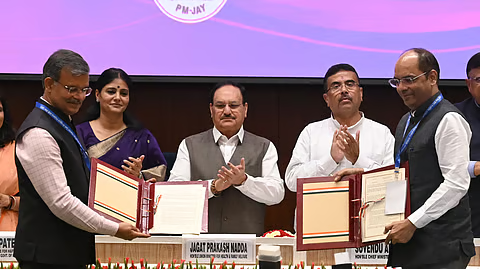
West Bengal has rejoined the Ayushman Bharat, Pradhan Mantri Jan Arogya Yojana (PM-JAY), making it the 36th state or Union Territory to implement the central government's health insurance programme and completing its nationwide rollout. The move is expected to extend coverage to approximately six crore people across roughly 1.43 crore families in the state.
A Memorandum of Understanding formalising the arrangement was signed at Vigyan Bhawan in New Delhi between the National Health Authority and the West Bengal government, with Union Health Minister JP Nadda and Chief Minister Suvendu Adhikari present at the ceremony.
Who Is Covered
The beneficiary pool under the agreement includes 1.24 crore eligible families identified under the scheme's standard criteria, along with approximately three lakh families of ASHA and Anganwadi workers and helpers, and nearly 16 lakh families of senior citizens aged 70 years and above. Each eligible family receives annual health cover of up to Rs 5 lakh for secondary and tertiary hospitalisation at empanelled public and private hospitals anywhere in the country.
A Return After Seven Years
West Bengal was among the states that adopted PM-JAY at its launch in September 2018 but withdrew from the programme on January 10, 2019, a gap of more than seven years. The new state government, which took office roughly a month before Monday's signing, had listed rejoining the scheme as a key election commitment.
The National Health Authority indicated that the central government's annual contribution toward PM-JAY implementation in West Bengal is projected at around Rs 1,000 crore. Beneficiaries will have access to cashless treatment at more than 36,000 empanelled hospitals across India. The scheme's portability feature was highlighted as particularly significant for the large number of migrant workers from the state.
Broader Programme Context
- PM-JAY beneficiaries nationally have collectively availed over 12 crore treatments valued at Rs 1.82 lakh crore since the scheme's launch.
- The Centre recently released Rs 527 crore to West Bengal under the National Health Mission.
- With West Bengal's inclusion, PM-JAY now covers all 36 states and Union Territories.
Chief Minister Adhikari framed the state's return to the programme as evidence of the advantages of coordinated governance between the state and central administrations, while the health minister noted that the scheme would now reach residents who had been outside its ambit for the better part of a decade.
Sources
timesofindia.indiatimes.com
Frequently asked questions
How many people in West Bengal are expected to get PM-JAY coverage now?
The move is expected to extend coverage to approximately six crore people across roughly 1.43 crore families in the state.
Who is included in the beneficiary pool?
The agreement includes 1.24 crore eligible families under the scheme’s standard criteria, about three lakh families of ASHA and Anganwadi workers and helpers, and nearly 16 lakh families of senior citizens aged 70 years and above.
What is the annual health cover under PM-JAY for eligible families?
Each eligible family receives annual health cover of up to Rs 5 lakh. It applies to secondary and tertiary hospitalisation at empanelled public and private hospitals anywhere in the country.
When did West Bengal leave PM-JAY, and when did it return?
West Bengal withdrew from the programme on January 10, 2019. It has now rejoined after a gap of more than seven years.
How much central contribution is projected for PM-JAY implementation in West Bengal?
The National Health Authority said the central government's annual contribution is projected at around Rs 1,000 crore.
Related
Study points to trauma-informed, community-based mental health care for refugees in India
Evidence from refugee health research and Indian community consultations suggests that support works best when it is culturally grounded, built around families and communities, and linked to the wider health system.

Nepal turns to DNA as flood victims remain nameless and forensic labs buckle under demand
Families of the missing are lining up for blood tests and forensic teams are racing to match them with bodies and body parts recovered after the August 26 Bhotekoshi flood.

Can restaurants be shut down immediately for poor hygiene? India’s food-safety law says yes, but only in limited cases
Section 32 of the Food Safety and Standards Act lets officials suspend a food licence at once if public health is at risk, while the usual route still runs through an improvement notice and a chance to fix violations.

Kerala High Court backs name change for mental health centres, pushes state on staffing and rights
A Bench said the label itself carries stigma while pressing Kerala to answer long-standing complaints about neglect, secrecy and poor conditions at three state-run facilities.

No comments yet
Be the first to comment.
Join the conversation